The Dishwasher Leak That Traveled Fifteen Feet
Back to that ranch house. When our lead tech pulled out the FLIR camera and panned across the dining room wall, a dark blue plume appeared on the screen, shaped like an upside down river delta. Water had wicked under the hardwood, followed the subfloor seam, and climbed the drywall behind the china cabinet. The homeowner gasped. The pinless meter read 28 percent moisture content in the bottom sixteen inches of drywall, well above the 16 percent dry standard for that wall assembly.
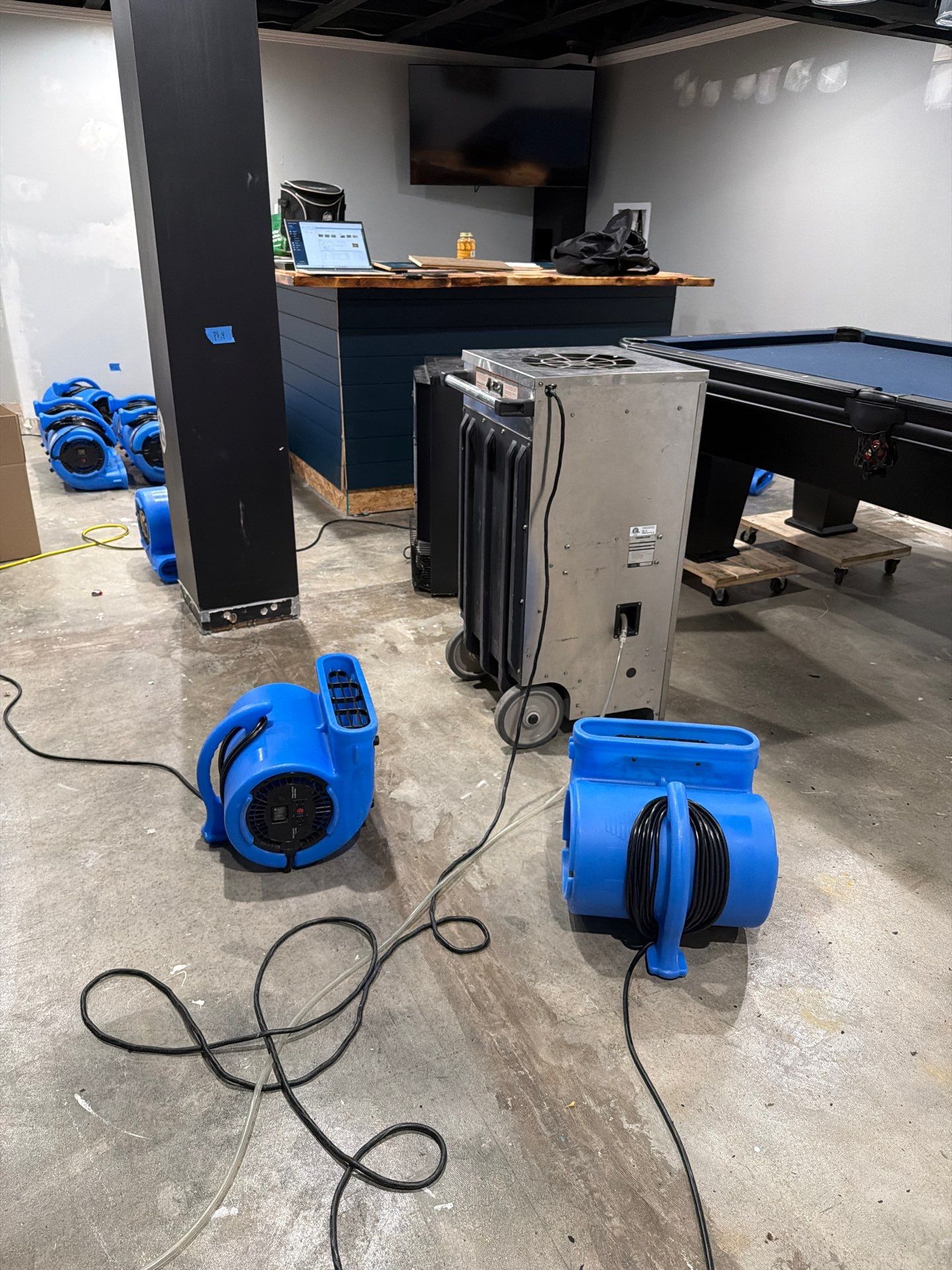
We tented the cabinet, set two air movers and a low grain refrigerant dehumidifier, and rescanned every twenty four hours. By day three the thermal image was uniform. By day five the meters confirmed it. Without the camera, that wall would have grown mold inside a month. If you want to understand why we treat the 48 hour window so seriously, our piece on how fast mold grows after water damage walks through the biology.
The dishwasher itself, by the way, looked perfectly normal from the front. The supply line had been weeping a teaspoon an hour from a hairline crack at the brass fitting. The homeowner had run that dishwasher twice a day for what we estimated was three or four weeks before the baseboard finally cupped enough to catch her eye. Thermal imaging is the only practical way to find slow leaks like that before the structure tells on itself.
The Upstairs Bathroom That Soaked a Ceiling
A Spyglass Falls family called us after noticing a quarter sized brown stain on their living room ceiling. The husband was ready to cut a six inch hole and patch it. We asked for ten minutes with the camera first. What the thermal image revealed was a cold patch shaped like a butterfly, roughly four feet across, centered on a joist bay that ran from the bathroom toilet flange to the exterior wall.
The wax ring had been weeping for weeks, probably months. Cutting one small hole would have missed nearly all of the saturated insulation. We mapped the perimeter with the camera, marked the drywall with blue tape, and removed exactly what was wet. The dry material stayed put. The homeowner saved roughly $1,800 in unnecessary demolition. This is also why our crews check hidden signs of water damage before a single tool comes out of the truck.
Why Thermal Imaging Beats Guessing
A standard inspection looks at surfaces. A thermal scan reads temperature differentials caused by evaporative cooling, which is what happens whenever water is present in a building material. Combined with moisture meters, you get a true picture of where water went, not where you think it went. For larger losses, this same approach drives our water damage restoration work from the first hour on site through the final dry out verification.
When a Spyglass Falls homeowner calls us with a fresh leak, we dispatch a crew with a camera, meters, and drying equipment in most cases within 2 hours. The map we build in the first half hour shapes everything that follows. Skip that step, and you are guessing with someone else's house.
When the Camera Says You Do Not Need Us
A Spyglass Falls condo owner called last winter convinced her upstairs neighbor had flooded her. The ceiling had a faint ring. We scanned. The thermal image was uniform, room temperature, no cold spot, no gradient. Moisture meters confirmed dry across the board. The stain was old, from a repair her building had done two years prior, and the paint had simply yellowed differently.
We did not charge her for an emergency mitigation she did not need. We explained what we saw, showed her the images on the camera screen, and suggested a coat of stain blocking primer. She paid for the assessment, which on most Spyglass Falls jobs is free anyway, and we left. If we cannot help, we will tell you directly. That promise only means something if we honor it on the easy calls too.
The Basement That Was Not Actually Dry
One Spyglass Falls landlord swore his basement had dried on its own after a sump pump hiccup. The carpet felt fine. The walls looked fine. He only called Spyglass Falls Water Restoration because his tenant complained of a musty smell. The thermal scan along the bottom of the drywall told the real story. A continuous cool band, between two and three feet up the wall, ran around three sides of the finished basement. Pin meter readings hit 32 percent behind the baseboard.
What had happened was simple. The carpet face dried. The pad underneath, and the bottom plate of the framing, never did. We pulled the base trim, drilled small inspection holes, and confirmed the mapping. The drying plan ran six days with containment, and we documented every reading for his insurance carrier.
The tenant moved out two weeks later anyway, citing the months of musty air, but the landlord avoided what would have become a full gut of the basement framing. He told us afterward that the most valuable part of the job was the paper trail. When his carrier questioned the scope, he forwarded the thermal images and the daily logs, and the adjuster approved the claim without a site visit.
The Limits of the Technology
Thermal cameras are not magic. They read surface temperature, not moisture directly, which is why we always pair the camera with pin and pinless meters. A sun warmed exterior wall can mask a wet cavity for an hour after the clouds break. A cold supply line behind drywall can look just like a leak if you do not know the framing layout. Our techs train on these false positives constantly, and we will often rescan the same wall two or three times under different conditions before we commit to a drying plan.
We also schedule scans for the right time of day when we can. Early morning, before the sun loads the south wall, gives us the cleanest baseline. For a recent Spyglass Falls attic job we came back at 6 a.m. specifically because the afternoon scan had been ambiguous. The morning image showed the leak path in seconds.
What a Moisture Map Actually Looks Like
When we hand you a moisture map, you are getting a floor plan sketch with affected areas shaded, paired with a reading log. A typical Spyglass Falls job includes:
- Thermal images of every affected wall, ceiling, and floor area, dated and labeled by room
- Pinless meter readings across a grid pattern, usually every two to three feet
- Pin meter readings at the base of walls and through any suspect material
- Ambient temperature and relative humidity logs from each affected room
- Dry standard readings from an unaffected area of the same material, so we know our target
That last item matters more than people realize. Dry is not a universal number. Dry plaster in a 1920s Spyglass Falls bungalow reads differently than dry drywall in a 2015 build. We measure an unaffected wall in the same house to set the goal, then we dry until your wet readings match.